
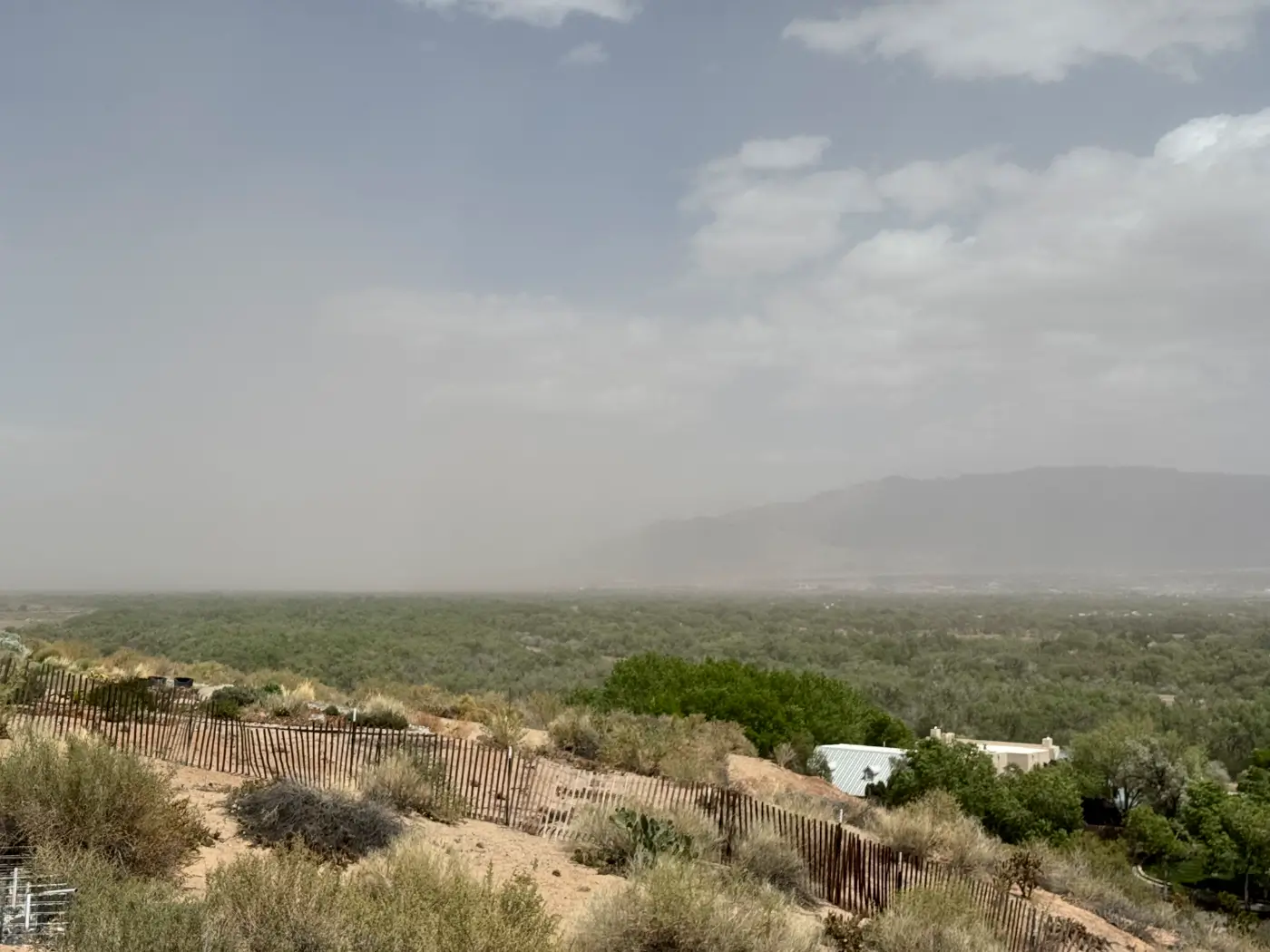
A dust storm is a wall of fine soil and sand lifted off dry ground by strong straight-line winds, and in the Albuquerque area it is mostly a spring event. From March through June, gust fronts rolling off the West Mesa and the open ground west and south of the city can push visibility down to a few hundred feet in minutes. The larger grit settles quickly on patios and windowsills. The fraction that matters to your heating and cooling equipment is the part fine enough to stay suspended in the air for hours, because that is the dust your system pulls straight through the return.
Inside the equipment, that fine dust does three things. It loads the filter far faster than the manufacturer's replacement interval assumes, which restricts airflow and forces the blower to work harder. It coats the evaporator coil and the blower wheel with a film that insulates the coil and throws the blower out of balance, so the system moves less air while drawing the same power. And whatever gets past the filter ends up circulating through the house, which is why a bad wind day is often followed by a week of dusty surfaces and irritated sinuses even with every window shut.
For most Albuquerque homes, a pleated filter in the MERV 8 to MERV 13 range is the right target. That band captures the fine airborne dust that causes the real problems without choking the system. Anything higher restricts airflow enough that some residential blowers cannot keep up, and a starved system runs hot in summer and short-cycles in winter. If you want to move above MERV 11, it is worth having the static pressure checked first so you know your equipment can handle it.
Skip the washable metal-mesh filters that get marketed for dusty climates. They stop lint and large grit, but their effective rating is low enough that the fine particulate that actually fouls coils passes right through. A one-inch pleated filter changed on schedule will do more for your air quality than a washable filter you rinse twice a year. If your system accepts a four- or five-inch media cabinet, that is the better long-term upgrade for a dusty area, because the deeper filter holds far more material before airflow starts to suffer.
Check it monthly from March through June, and plan to replace it monthly if you are running a one-inch filter. The ninety-day interval printed on the package assumes a clean-air environment, which the Rio Grande Valley in April is not. A single bad wind week can gray out a filter that looked fine the day before.
The check itself takes about a minute. Pull the filter, hold it up to a light, and if you cannot see light through the pleats, it is done. A filter that is loaded but not visibly gray still needs to go if it has been in place through a major storm, because the loading that restricts airflow happens well before the surface looks dirty.
Late winter or early spring is the right window, before the wind picks up and before the first hot stretch puts a load on the system. A tune-up at that point catches the things a filter change cannot reach: the blower wheel, the evaporator coil, the condensate drain, and the ductwork itself. The blower wheel is the one homeowners never see and the one dust affects most, because a film on the fins measurably drops the air the system can move.
A technician will also check the return-side ductwork for leaks, which matters more in a dusty climate than almost anywhere else. A return leak in an unconditioned attic or crawlspace pulls dusty air in downstream of your filter, so it bypasses filtration entirely. Sealing that leak often does more for indoor dust than any filter upgrade. Our team can handle that inspection as part of a seasonal cooling system service visit.
Most dust enters through the building envelope rather than the HVAC system, so sealing is where the effort pays off. Replace worn weatherstripping on exterior doors, particularly the door sweeps, since the gap under a door is usually the largest single opening in the house. Caulk the gaps where window frames meet the wall and where trim has pulled away over time. Heavy-duty mats at every entry catch a surprising amount of what comes in on shoes.
Evaporative coolers deserve special attention here. A swamp cooler works by pulling outside air through wet pads and pushing it into the house, which means during a dust storm it is actively drawing dusty air indoors. If a storm is moving in, shut the cooler down and close the relief windows until it passes. Off-season, make sure the unit is covered and the ductwork damper is closed, because an uncovered cooler is an open hole in your roof that dust falls straight through all winter.
It can, though the effect is local rather than dramatic. Bare, disturbed soil on your own lot is a dust source, so covering it with gravel, decomposed granite, or low ground cover stops your yard from contributing to the problem. Windbreak plantings on the prevailing upwind side, which in most of the metro means the west and southwest, slow the air near the ground and drop some of the load before it reaches the house. Native and low-water species handle the conditions without adding much to your irrigation, and they do not need the constant soil disturbance that undercuts the whole point.
Dust storms in New Mexico often arrive with the same front that brings high wind, hail, or a monsoon downburst, so it is worth thinking about the envelope as a whole. Keep the roof in good condition and have flashing and any roof penetrations checked, since wind-driven grit works into small gaps and holds moisture there. Make sure the electrical system can handle what follows a storm, because outages and surges are common when the wind takes lines down, and older panels are the weak point in a lot of Albuquerque homes.
Indoors, a HEPA portable purifier in the bedroom is a reasonable addition for anyone with allergies or asthma, and it will pull down the fine particulate that gets past the central system after a heavy storm. It is a supplement to good filtration, not a substitute for it.
Dust changes the failure math. A system that would run fifteen years in a clean environment gives up efficiency steadily here as the coil fouls and the blower loads up, and the components that fail first are the ones that have been working against restricted airflow for years. Compressors, blower motors, and heat exchangers all last longer when the system is moving the air it was designed to move. Consistent maintenance is what keeps that airflow where it belongs.
The cost side of it is simple enough. A fouled coil and a loaded filter mean the system runs longer for the same result, which shows up on the bill every month of cooling season and again all winter. Catching it takes a scheduled visit rather than a service call after something breaks in July.
