
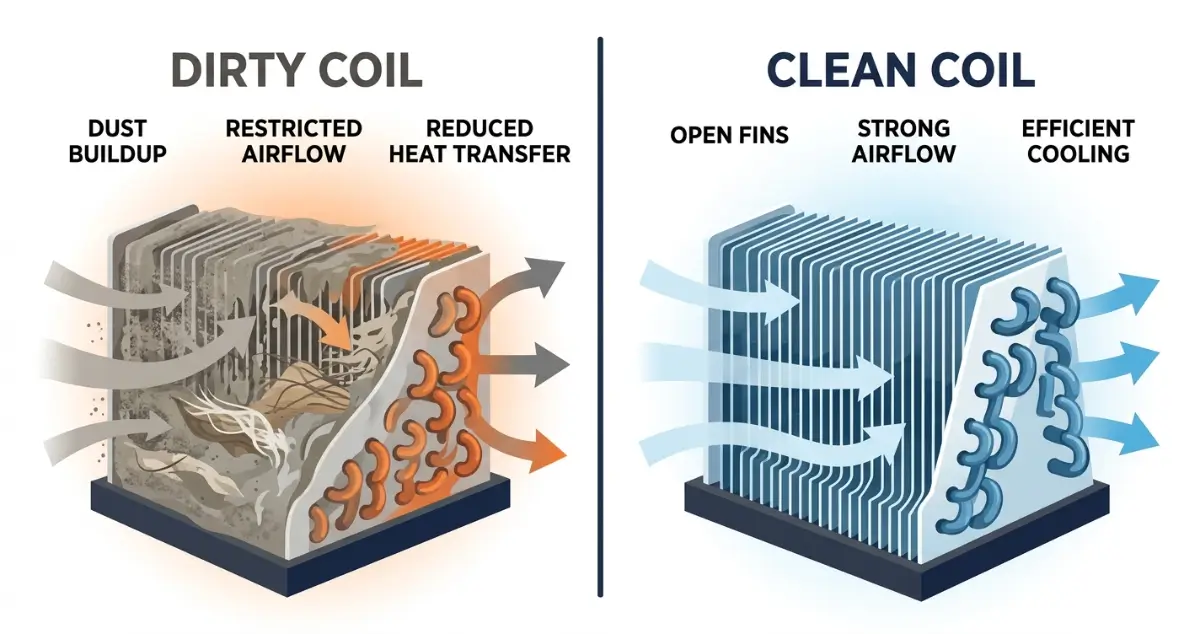
When most homeowners think about AC maintenance, they think about filters, thermostats, or the outdoor unit. What consistently gets overlooked is the evaporator coil — the component that actually absorbs heat from your home. In the field, we often refer to it as the heart of your cooling system. And like anything that has to breathe and exchange energy, when it gets clogged, everything downstream starts to struggle.
Deep coil cleaning isn't just about making your system cleaner. It directly impacts how well your AC cools, how long it runs, and how long it lasts. Here's what that actually looks like from a technician's perspective.
Dirty coils aren't just dusty — they tell a story about the home and its environment. In the high desert, we consistently see a mix of contaminants that go well beyond what a standard filter can stop.
Fine Dust and Silt
High-desert environments produce an extremely fine, almost powdery dust that's small enough to bypass lower-quality filters and settle deep into the coil. Once moisture hits it, it turns into a thin muddy film that bonds to the metal and is nearly impossible to dislodge without a proper cleaning.
Cottonwood and Organic Debris
In late spring and early summer, cottonwood seeds accumulate quickly. The fibers weave into the coil fins and form a dense mat that blocks airflow — almost like laying a blanket over the system.
Pet Hair and Indoor Buildup
In homes with pets, we regularly find a thick layer of dander and hair on the leading edge of the coil. Combined with cooking oils that migrate from the kitchen, it creates a sticky surface that traps everything else that passes through.
Hard Water Residue from Swamp Cooler Conversions
Many homes that transitioned from evaporative cooling to refrigerated air still carry remnants of hard water minerals — calcium, lime, and scale. These deposits act as insulation on the coil surface, directly reducing its ability to transfer heat.
The evaporator coil's job is to absorb heat from the air passing through it. When the surface is clean, heat transfer happens efficiently. When it's coated in debris, that process breaks down in ways that affect the entire system.
A dirty coil acts like insulation — instead of pulling heat out of the air, it struggles to absorb it. The result is air that feels cool but not cold. When buildup gets heavy enough, it physically blocks airflow, forcing the system to work harder just to move air through. Because heat isn't transferring efficiently, the system runs longer to reach the same temperature, or in some cases never gets there at all during peak afternoon heat.
This is where homeowners notice the difference almost immediately.
Systems that were only achieving a 10–12°F temperature drop across the coil routinely return to a healthy 16–20°F range after a proper cleaning. In practical terms, that means rooms cool faster, the system actually reaches the thermostat setpoint, and the air coming from the vents feels noticeably colder. Airflow improves significantly — especially in systems heavily impacted by pet hair or cottonwood — and homeowners often notice better distribution in rooms that previously felt weak. With the coil doing its job properly again, run cycles shorten, compressor strain decreases, and energy use drops.
This is the part most homeowners don't see, but it's where the real value of regular coil cleaning lies.
Frozen Coils
When airflow is restricted and heat transfer is reduced, the coil can drop below freezing and begin to ice over. Once that happens, airflow drops even further and the system can shut down completely — often on the hottest day of the year.
Compressor Stress and Failure
The compressor is the most expensive component in your AC system. Dirty coils force it to run hotter and longer, accelerating wear and significantly increasing the risk of failure over time.
Blower Motor Strain
A clogged coil increases static pressure throughout the system, forcing the blower motor to work harder. Over time that leads to premature motor failure or control board issues that could have been avoided.
Drain Line Clogs and Water Damage
Debris from a dirty coil often ends up in the condensate drain. Left unaddressed, that leads to clogs, water backups, and potential damage inside the home — sometimes behind walls or in ceilings.
Odors and Air Quality
Moisture on the coil combined with organic debris creates conditions for biological growth. If you've noticed a musty or "dirty sock" smell when the AC kicks on, the evaporator coil is usually the source.
Not all coil cleanings are the same. A standard maintenance visit may include a light rinse or surface wipe-down. A deep coil cleaning is considerably more involved and is typically recommended when buildup is significant.
A proper deep cleaning starts with disconnecting power and protecting sensitive components — the control board and blower motor in particular — from moisture. In many systems, the coil sits inside an A-frame housing, and accessing the underside where most of the buildup actually concentrates requires partial disassembly.
Before any water is introduced, loose debris like dust, pet hair, and cottonwood is removed with light brushing and a vacuum — skipping this step turns dry buildup into mud. A non-acidic foaming cleaner is then applied to break down grease, dust, and mineral deposits deep within the fins, followed by a controlled low-pressure rinse to flush contaminants out without bending or damaging the fins. Once reassembled, the system is tested to confirm improved airflow and temperature performance before the job is complete.
Not every system needs one, and honesty matters here. If your system is cooling properly, airflow is strong, there are no unusual odors, and the coil is visibly clean, a standard tune-up is likely sufficient.
A deep cleaning is worth considering if your AC runs constantly but struggles to hit the set temperature, airflow feels weak even with a fresh filter, you notice musty odors at startup, or the system seems to fall behind during late afternoon heat. If the unit has never had a deep cleaning after several years of use, that alone is a strong reason to have it inspected.
Homes with pets, properties near open land or heavy dust exposure, areas with seasonal cottonwood, and homes that transitioned from swamp cooling all see faster coil buildup and may need cleaning more frequently than the average system.
Deep coil cleaning restores your system's ability to do its job. When the coil is clean, heat transfer improves, airflow returns to normal, runtime decreases, and every component in the system experiences less stress. In a climate where your AC runs hard for months at a time, those improvements make a measurable difference in both comfort and long-term reliability.
If your system isn't keeping up the way it used to — or if it's been several years since the coil was last inspected — it's worth having a professional take a look. A quick evaluation can determine whether a standard tune-up is enough or whether a deeper cleaning would make a meaningful difference.
Contact the team at Number One Plumbing, AC, Solar & Electric to schedule an inspection.
For most homes in the Albuquerque area, an annual inspection is a good baseline. Homes with pets, significant dust exposure, or cottonwood nearby may benefit from cleaning more frequently — sometimes every season.
A standard cleaning typically involves a surface rinse or light brush-down during a routine tune-up. A deep cleaning involves full access to the coil interior, dry debris removal, chemical treatment, and a controlled rinse — and is necessary when buildup is heavy or performance has noticeably declined.
Surface debris like cottonwood can be carefully removed from the outdoor unit by a homeowner. The evaporator coil inside the air handler requires proper access, the right cleaning agents, and care around sensitive components — DIY attempts often cause fin damage or introduce moisture where it shouldn't go.
A musty or "dirty sock" smell at startup is one of the most common signs of biological growth on the evaporator coil. A deep cleaning combined with a drain line flush typically resolves it.
A system working against a clogged coil runs longer and less efficiently than it should. Restoring clean heat transfer surfaces reduces runtime, which typically results in lower energy consumption — though exact savings depend on the condition of the system and the home overall.
Signs include little to no cool air from the vents, ice visible on the refrigerant lines near the air handler, or water pooling around the unit as ice melts. If you suspect a frozen coil, turn the system to fan-only mode to thaw it and call for an inspection before running it again.
