
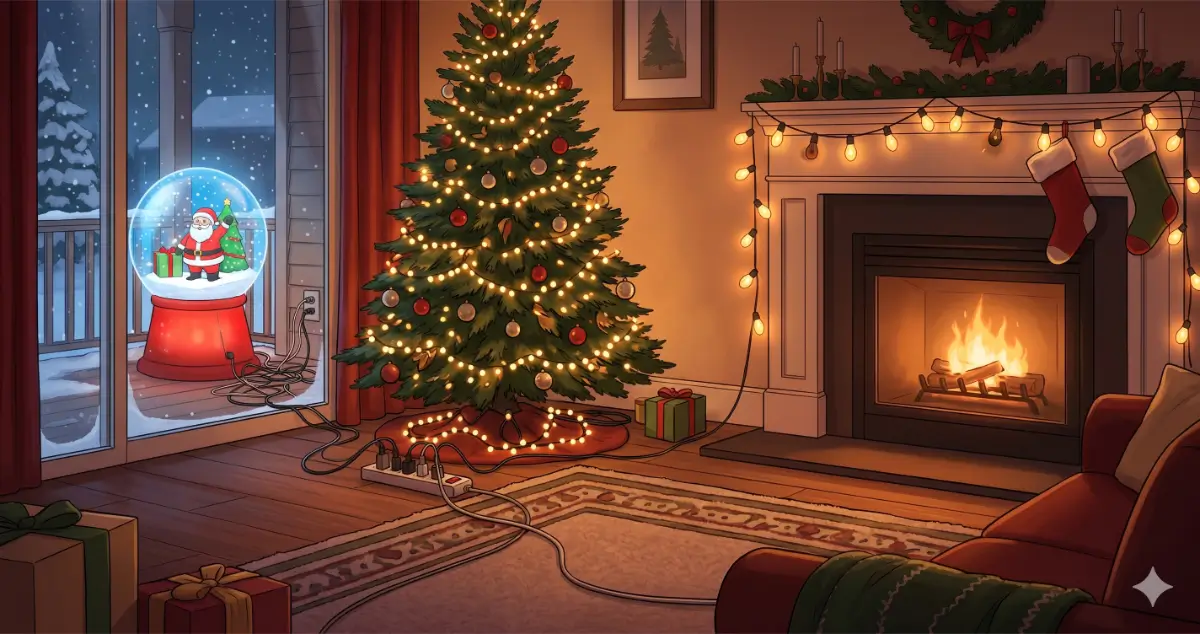
The holidays are supposed to feel warm, safe, and inviting — but from an electrician's perspective, they're also one of the most electrically stressful times of the year for a home. At Number One Plumbing, AC, Solar & Electric, our technicians don't install holiday decorations, but every year we're called in to deal with the consequences of them. What we find isn't carelessness. It's usually well-intentioned homeowners pushing their electrical systems past limits they didn't know existed.
Here's what we consistently see in the field — and what every homeowner should understand before plugging anything in this season.
The most common issue we see is straightforward: too much load on a single circuit. Holiday lighting, inflatables, and outdoor décor stack quickly onto circuits already powering daily life — and circuits aren't designed to handle sudden, sustained increases in load. When overloaded, wires begin to heat up behind the walls long before anything visibly fails.
We responded to one home running three large inflatables and multiple light strands through a single exterior outlet. The breaker kept tripping, so the homeowner taped it into the on position. That's not a workaround — that's removing your last line of defense. The fix is simpler than most people think: spread decorations across multiple circuits, avoid plugging power strips into power strips, and use surge protectors with built-in shutoff rather than standard strips.
Holiday lights don't fail all at once — they degrade over time. Cracked insulation, loose sockets, and exposed wiring are among the most common hazards we encounter, and even minor damage can create arcing that produces heat and sparks capable of igniting nearby materials.
One homeowner wanted to hang vintage glass bulb lights that had been passed down through the family. When we handled them, the insulation crumbled in our hands, exposing live copper that would have sparked on contact with the roof. The right move with aging light strands is always replacement, not repair. Electrical tape over cracked insulation is not a fix. If you're due for an upgrade anyway, LED strands run significantly cooler than incandescent bulbs and put far less stress on the circuit.
A dry tree doesn't just burn — it accelerates fire rapidly. During a post-holiday takedown, we handled a tree that hadn't been watered in weeks. A brittle branch snapped off and fell onto a warm bulb and nearly ignited on contact. Dry needles act like fuel: combined with heat or a spark, a tree can transition from smolder to full fire in seconds.
Water your tree daily, keep it at least three feet from any heat source, and avoid older incandescent bulbs that generate significant heat at the bulb surface. If the tree has been up for several weeks without consistent watering, that's a risk worth taking seriously before the next time you turn the lights on.
Extension cords are one of the most misunderstood tools in a home. We've pulled back rugs to find cords fused to carpet fibers — the insulation literally melted from trapped heat buildup. We also regularly find indoor-rated cords used outside, exposed to moisture and temperature swings they were never designed to handle.
Indoor cords aren't rated for weather exposure, heat buildup under rugs or furniture breaks down insulation faster than most people realize, and moisture intrusion in outdoor connections can lead to short circuits or shock hazards. For any outdoor holiday use, look for cords marked "SJTW" — that's the outdoor rating you need. Keep connections elevated off the ground, and never run any cord under a rug or through a doorway where it will be compressed repeatedly.
While kitchen fires don't originate from the electrical system, they spike sharply during the holidays and frequently intersect with it. Distraction combined with high heat is the core risk — add multiple electrical appliances running simultaneously on already-loaded kitchen circuits, and the system is under maximum stress.
One of our technicians, working outside a home, watched a homeowner step away from a pot of hot oil. Within minutes smoke was filling the kitchen. Never leave cooking unattended during high-heat preparation, keep a Class B or K fire extinguisher accessible in the kitchen, and avoid stacking additional appliance load onto kitchen circuits during large holiday meals.
One of the most dangerous assumptions we hear is that if something fits in the outlet, it's safe to use. That's not how electrical systems work. Outlets don't measure safety — they just provide access to power. The actual limits exist behind the walls, in wiring and breakers most homeowners never see. A breaker not tripping does not mean you're safe. It means the system hasn't reached the point of mechanical failure yet — which is a different thing entirely.
Our technicians draw a clear line when evaluating holiday electrical setups. Some issues are simple to address on the spot: breaking up long chains of lights, elevating outdoor plug connections off the ground, switching from incandescent to LED, and redistributing load across multiple circuits. These take minutes and meaningfully reduce risk.
Others are red flags that require a licensed electrician. Hot outlets or plugs, buzzing or humming from the breaker panel, discolored or melted outlet faces, and frequent breaker trips are all signs that what you're dealing with is no longer about decorations — it's about the underlying electrical system.
Holiday lighting frequently exposes weaknesses that were already present in a home's electrical system. Dedicated circuits for exterior lighting, GFCI-protected outdoor outlets, weatherproof in-use outlet covers, and heavy-duty timers for larger displays aren't just conveniences — they're safety improvements that pay off well beyond the holiday season.
After your decorations have been running for about an hour, do a simple check. Touch your extension cords, your plugs, and your outlet faceplates. Cool to the touch means you're likely in good shape. Warm means you're pushing the limit and should redistribute the load. Hot means unplug immediately — that heat is the earliest warning sign of a problem developing behind the wall.
Your home's electrical system was designed for your life, not your decorations. Most circuits are already handling 50 to 60 percent of their capacity with everyday use. A full holiday display running for hours every night pushes that further than most homeowners realize.
If something doesn't feel right — or your system is showing any of the signs above — it's worth having a licensed electrician take a look before the season gets fully underway.
Call us today to schedule an inspection.
It depends on the circuit, but a safe general rule is to stay under 1,500 watts per circuit and avoid connecting more than three standard light strands end-to-end. LED strands make this much easier since they draw a fraction of the power of incandescent bulbs.
It's not recommended, especially with older incandescent strands or an aging electrical system. Use a timer to automatically shut lights off after a set number of hours — it reduces risk and extends the life of the strands.
A warm outlet means the circuit is under significant load and heat is building up at the connection point. Redistribute your decorations across different circuits and have the outlet inspected if it continues.
No. Indoor cords aren't rated for moisture or temperature variation. Even brief outdoor exposure can compromise the insulation. Always use cords marked "SJTW" for any outdoor application.
Your circuit is overloaded. The breaker is doing exactly what it's supposed to do. The solution is to spread the load across multiple circuits — not to reset the breaker repeatedly, and never to bypass or tape it.
A basic power strip just adds outlets — it offers no protection. A surge protector includes circuitry that shuts off power when it detects a dangerous spike. For holiday lighting, always use a surge protector with a built-in shutoff rather than a standard strip.
