Walk into almost any modern kitchen and you'll find more electrical demand than most homes were ever designed to handle. Air fryers, espresso machines, microwaves, smart refrigerators, countertop ovens, high-speed blenders, wine coolers, under-cabinet lighting, charging stations — the list keeps growing. The problem is that many Albuquerque homes, especially in areas like Nob Hill, Ridgecrest, Old Town, and the North Valley, still rely on electrical systems originally designed for a toaster and a coffee percolator.
That mismatch is where the trouble begins. After years of real-world electrical service calls, one thing becomes consistently clear: kitchen electrical issues are rarely about the appliance itself. They're almost always about the simultaneous demand placed on the circuit.
Walk into almost any modern kitchen and you'll find more electrical demand than most homes were ever designed to handle. Air fryers, espresso machines, microwaves, smart refrigerators, countertop ovens, high-speed blenders, wine coolers, under-cabinet lighting, charging stations — the list keeps growing. The problem is that many Albuquerque homes, especially in areas like Nob Hill, Ridgecrest, Old Town, and the North Valley, still rely on electrical systems originally designed for a toaster and a coffee percolator.
That mismatch is where the trouble begins. After years of real-world electrical service calls, one thing becomes consistently clear: kitchen electrical issues are rarely about the appliance itself. They're almost always about the simultaneous demand placed on the circuit.
The most common issue is what I call the hidden overload. Homeowners look at several outlets across the backsplash and assume they're on independent circuits. In reality, many older kitchens have those outlets daisy-chained together on a single 15-amp or 20-amp circuit.
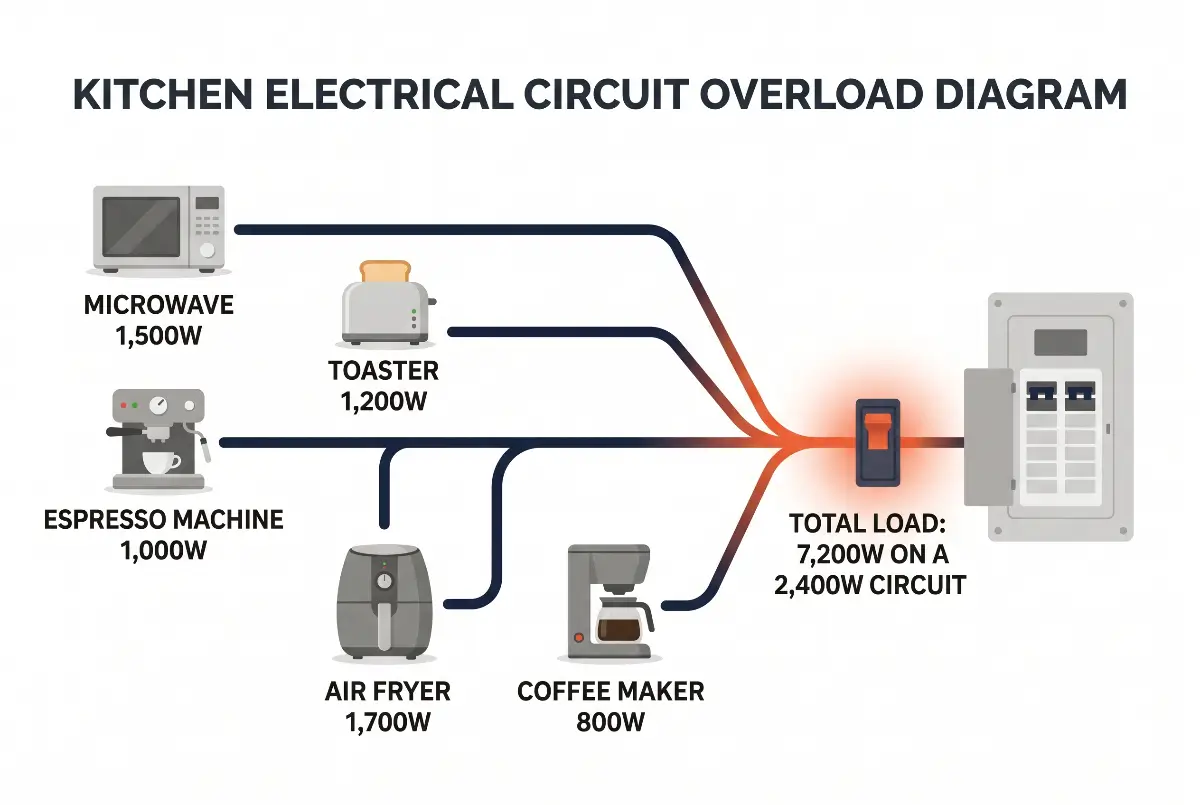
The microwave starts running. Someone turns on the toaster. The espresso machine heats up. The air fryer kicks on. Suddenly the circuit is operating right at its limit, and that's when homeowners start noticing flickering lights, warm outlets, tripping breakers, buzzing sounds, and occasionally a burning or "fishy" smell. Those aren't random annoyances — they're warning signs.
Microwaves are the biggest culprit in kitchen overload situations. A modern unit can pull 1,200 to 1,500 watts on its own. Add a toaster or coffee maker to the same circuit and you're pushing the breaker to its threshold — which is why homeowners experience what's sometimes called nuisance tripping when multiple appliances run simultaneously.
But here's the part that doesn't get talked about enough: repeated near-overloads generate heat over time, and electrical heat is cumulative. Even if the breaker doesn't trip every single time, the wiring insulation slowly degrades, outlet tension weakens, connections loosen, and eventually arcing begins inside the wall. That's how small electrical annoyances become fire hazards.
Albuquerque has one of the most varied electrical landscapes I've worked in. Historic adobe homes, mid-century ranches, 1940s Nob Hill bungalows, 1960s tract housing, DIY additions, casitas, converted garages — the electrical systems in these homes often tell the entire history of the structure. And cosmetic kitchen remodels frequently hide serious electrical shortcuts.
One memorable service call involved a beautifully remodeled 1940s home in Nob Hill — quartz counters, new tile, wine fridge, designer lighting, high-end appliances. Every time the dishwasher entered the heated dry cycle, the kitchen lights dimmed and the breaker eventually tripped. The issue turned out to be that instead of running a proper dedicated circuit through the difficult plaster walls, the remodel had tapped the dishwasher and disposal into an existing lighting circuit. We also discovered buried junction boxes hidden behind the new backsplash tile — a major code violation. This kind of thing is surprisingly common in flipped homes: beautiful finishes concealing outdated or overloaded electrical work.
The most dangerous assumption homeowners make is that if the power came back on, the problem is solved. It usually isn't.
The clearest example is what electricians call the bigger breaker trap. A homeowner gets tired of a 15-amp breaker tripping and replaces it with a 20-amp breaker. The problem is that breakers protect the wire, not the appliance. If 14-gauge wiring is connected to a 20-amp breaker, the wire itself becomes the fuse — meaning the wiring can overheat inside the walls before the breaker ever trips. This is how hidden electrical fires start.
Another temporary fix that becomes permanent: heavy-duty extension cords behind appliances. Microwaves on power strips, refrigerators on extension cords, countertop ovens sharing adapters, cords tucked behind cabinetry — the issue in every case is heat. Extension cords aren't designed for continuous high-draw kitchen loads. Over time, plugs oxidize, resistance increases, heat builds, and connections begin failing. Most homeowners never realize there's a problem until they smell burning plastic.
One of the more striking service calls involved an older Albuquerque home with original two-prong outlets. The homeowner had bought a modern stainless steel refrigerator and used a simple 3-to-2 prong adapter. They started feeling a tingle every time they touched the refrigerator while barefoot on Saltillo tile — the floor had recently been mopped. The refrigerator had developed a minor electrical fault, but without a proper grounded circuit, the electricity had nowhere to go. The homeowner's body became the path to ground. That situation could have ended much worse.
There's a point where an older kitchen stops being quirky and starts being dangerous. In my experience, that point arrives when you can't run the microwave and toaster simultaneously, lights dim every time a large appliance starts, breakers trip weekly, outlets feel warm to the touch, you occasionally smell melting plastic, or you find yourself constantly rearranging what can run at the same time. When you've hit that point, the electrical system has already failed to meet modern demand — it's just a matter of when that failure becomes visible.
Warm outlets or wall plates usually indicate undersized wiring or failing connections. Flickering lights mean voltage is dropping because appliances are drawing more current than the circuit can cleanly supply. Frequent breaker trips point to overloaded or deteriorating circuits. Buzzing sounds suggest loose connections or arcing may already be occurring. Two-prong outlets are a grounding issue that creates real risk with modern appliances. A full panel packed with tandem breakers means capacity is likely maxed out. And if you have a Federal Pacific or Zinsco panel, that's a conversation that needs to happen regardless of whether you're seeing symptoms — both brands are known for failing to trip during overloads.
One of the most common and expensive mistakes is spending tens of thousands on cabinets, countertops, backsplashes, lighting, and smart appliances — while leaving 60-year-old wiring behind the walls. The professional rule is simple: if the walls are open, rewire them. Adding dedicated circuits after the tile, cabinets, and countertops are finished is dramatically more expensive than doing it during the remodel. The most important part of a modern kitchen is the part you can't see.
Your appliances have evolved far faster than your home's wiring. We routinely expect electrical systems built decades ago to support a lifestyle they were never designed for — and convenience should never be mistaken for safety. Just because an outlet exists doesn't mean the circuit can safely handle what you're plugging into it.
Electrical systems don't fail all at once. Insulation weakens, outlets loosen, breakers degrade, and heat accumulates over years. If you're already thinking twice before turning on an appliance, juggling what can run simultaneously, or watching your lights flicker regularly, your system is telling you something. It's worth listening before it becomes an emergency.
Call us today to schedule a kitchen electrical inspection.
Most high-draw appliances do, including microwaves, dishwashers, garbage disposals, refrigerators, countertop ovens, air fryers, wine coolers, and espresso machines. A licensed electrician can assess your current setup and identify what needs its own circuit.
The clearest sign is that tripping one breaker cuts power to multiple outlets. You can also use an outlet tester or have an electrician trace the circuits. Many older Albuquerque kitchens have far fewer circuits than homeowners assume.
For small, low-draw items like phone chargers or under-cabinet lighting, a quality power strip is generally fine. For high-draw appliances like microwaves, air fryers, or countertop ovens, it's not — these should be on dedicated circuits plugged directly into the wall.
A warm outlet is a warning sign of undersized wiring, a failing connection, or an overloaded circuit. Stop using it and have it inspected. It's not something to monitor — it's something to fix.
This is a voltage drop caused by the microwave drawing more current than the circuit can cleanly supply. It typically means the microwave is sharing a circuit with other loads and needs its own dedicated circuit.
If your panel is already near capacity, outdated, or a known problem brand like Federal Pacific or Zinsco, yes — address the panel first. Adding dedicated circuits to an already maxed-out panel doesn't solve the underlying problem.
