Es posible que no los notes al principio. Un leve goteo debajo del fregadero. Un leve silbido detrás de una pared. Un aumento repentino en su factura de agua que no coincide con su consumo. Estos son los «sifones silenciosos», es decir, las fugas ocultas en las tuberías que desperdician agua silenciosamente, aumentan los costos y preparan el terreno para daños costosos.
After working in older neighborhoods throughout the city — from Nob Hill and Ridgecrest to the North Valley and Old Town — smart thermostat installations here are rarely as simple as the "5-minute DIY install" videos online make them seem. In newer suburban homes, the process is often straightforward. In older Albuquerque homes, it can uncover decades of wiring modifications, swamp cooler conversions, hidden electrical issues, Wi-Fi problems caused by adobe walls, and HVAC systems that were never designed to support modern smart technology.
The thermostat itself usually isn't the problem. The house is.
Smart thermostats are designed around a fairly standard set of assumptions: modern low-voltage wiring, consistent HVAC configurations, reliable Wi-Fi, properly installed furnace control boards, dedicated C-wires, and standard ductwork. Older Albuquerque homes often have none of those things.
Our housing stock is remarkably diverse. One house might be a 1940s adobe with original cloth-wrapped wiring. Another may have started with evaporative cooling and later converted to refrigerated air. Another may have had multiple additions built over 50 years by different contractors — or by homeowners themselves. That creates what I call the Albuquerque Surprise: you pull the thermostat off the wall expecting a routine install, and suddenly you're looking at wiring from three different decades, abandoned swamp cooler circuits, or a furnace transformer that's barely holding on.
The Swamp Cooler to Refrigerated Air Hybrid Mess
This is one of the most common situations we encounter. A homeowner upgraded from swamp cooling to refrigerated air years ago, but the original wiring was never fully redone. The result is a tangle that can include old swamp cooler switches still connected, mixed voltage systems, abandoned relay wiring, and line-voltage components tied into low-voltage thermostat wiring.
This becomes a serious problem because most smart thermostats require a clean 24V low-voltage system. Many older swamp cooler systems used 120V line voltage. Connecting a Nest or Ecobee directly into the wrong wiring can destroy the thermostat — and potentially create a fire hazard inside the wall.
The Phantom C-Wire
Most homeowners have heard about the C-wire problem, but in Albuquerque we often run into something worse: the ghost wire. You remove the old thermostat and find five wires in the wall. Looks perfect. But in countless homes across the city, the blue wire exists behind the thermostat without actually being connected to anything at the furnace control board — it was simply tucked into the wall decades ago during the original installation.
A homeowner connects it anyway because a YouTube video said "just hook the blue wire to C." The problem is that older furnace transformers often lack the capacity to properly support a Wi-Fi thermostat alongside relays and accessories. That can lead to intermittent failures, constant rebooting, blown fuses, transformer overheating, or a complete HVAC shutdown during peak summer heat.
Adobe Walls and Wi-Fi Dead Zones
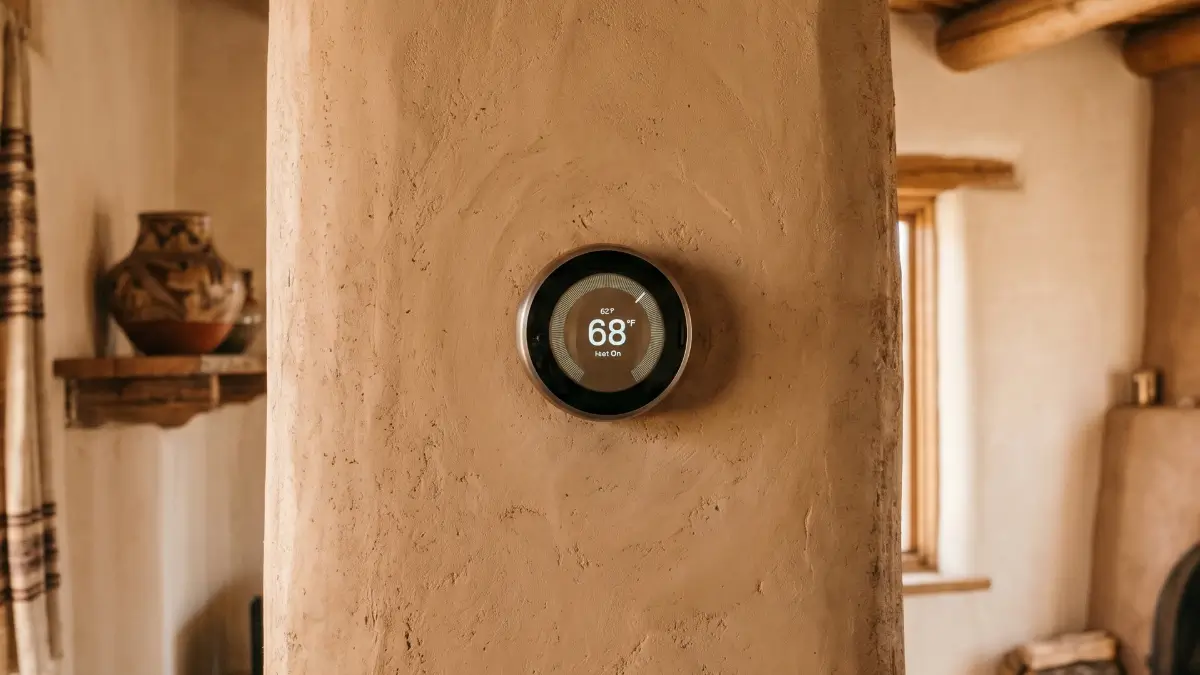
One thing national HVAC blogs almost never discuss is how badly thick adobe walls interfere with Wi-Fi signals. Traditional adobe homes in Albuquerque are exceptional for thermal stability — but they're genuinely terrible for wireless communication. Two feet of mud and straw acts almost like a signal barrier.
I've been in homes where the thermostat installation was technically perfect, but the device constantly disconnected because it was mounted on a thick interior adobe wall far from the router. Homeowners assume the thermostat is defective, the HVAC system is failing, or the router needs replacing. In reality, the fix is often a nearby mesh Wi-Fi node or relocating the thermostat entirely — not a new device.
This surprises people, but there are situations where I actively recommend against them.
Swamp Cooler Homes
If your home still uses evaporative cooling, a smart thermostat is often more headache than benefit. Most standard smart thermostats aren't designed for multi-speed swamp cooler motors, line-voltage controls, or the unique operation of evaporative systems. Even with relays and adapters, the thermostat still can't handle the most important part of swamp cooler operation: airflow management and window balancing. That remains manual regardless of how smart the device is.
Traditional Adobe Homes
Older adobe homes already regulate temperature exceptionally well because of their thermal mass. These homes don't fluctuate temperature quickly the way modern stick-frame construction does, which means many of the features that make smart thermostats valuable — occupancy sensing, learning schedules, aggressive setback programming, geofencing — simply don't produce the energy savings manufacturers advertise. In many adobe homes, a quality programmable thermostat performs just as well.
A smart thermostat is not magic. In Albuquerque, your summer electric bill is driven by peak-hour cooling demand, insulation quality, duct leakage, solar gain, aging equipment, and overall system efficiency. The thermostat alone usually isn't the main factor in any of those.
The honest framing I give homeowners is this: a smart thermostat is a convenience tool first and a savings tool second. If you want to adjust your AC remotely while driving back from Santa Fe, a smart thermostat is genuinely useful. If you expect it to cut your PNM bill in half, you're likely going to be disappointed.
One install in Nob Hill captured everything that makes older Albuquerque homes unique. The homeowner had a beautiful 1948 Pueblo Revival home and wanted a high-end Ecobee. He called convinced he had simply blown a fuse during installation — every time he replaced it, it blew instantly again.
When I arrived, the thermostat wiring turned out to be original cloth-wrapped copper. But the real problem was hidden deeper in the house. Decades earlier, someone had enclosed a back porch and converted it into a laundry room. Rather than properly extending the HVAC system, they had spliced the thermostat wiring to control a small electric kickspace heater. The old Honeywell round thermostat had tolerated the voltage drop. The Ecobee would not.
During the DIY install, the old brittle insulation inside the lath-and-plaster wall shifted just enough to short against the metal lath embedded in the plaster. The thermostat wasn't the issue — the house infrastructure was. We ended up running entirely new thermostat wire, isolating the laundry room heater, repairing unsafe electrical work, and upgrading the wiring path completely. The homeowner ended up saving far more money fixing the hidden electrical problem than the smart thermostat itself would have ever saved in energy costs.
The most common mistake is assuming every system is standard. YouTube installs look universal. They aren't — especially here. Homeowners routinely bridge wires incorrectly, bypass old swamp cooler switches, misidentify voltage, damage brittle wiring, or short furnace control boards during installation.
The single most dangerous mistake is connecting a low-voltage smart thermostat to a line-voltage system. This happens more often than most people realize in older adobe homes, electric baseboard systems, old additions, and aging swamp cooler configurations. A Nest or Ecobee connected to 120V wiring doesn't just fail — it can melt internally and create a fire hazard behind the wall. If you ever measure 120V at the thermostat wires, stop immediately and call a professional.
Don't ask whether your thermostat is smart enough. Ask whether your HVAC system is healthy enough to support it. That's the real question in older Albuquerque homes.
Before buying a smart thermostat, inspect the wiring, verify the transformer capacity, confirm you have a true C-wire, and evaluate the overall health of the HVAC system. A smart thermostat is a monitor, not a mechanic. It can tell you the house is hot — it cannot fix failing wiring, overloaded transformers, clogged coils, poor ductwork, or decades of handyman electrical modifications.
A simple programmable thermostat on a rock-solid electrical system will outperform a high-end smart thermostat connected to crumbling infrastructure every single time. When the technology and the system behind it are both healthy, that's when a smart thermostat actually becomes a smart investment.
Call us today to schedule an HVAC system evaluation before your next thermostat upgrade.
Most smart thermostats require a C-wire to power the device continuously. Some models include adapter kits for homes without one, but in older Albuquerque homes the C-wire situation is often more complicated than it appears — the wire may exist at the thermostat but not be connected at the furnace end.
Standard smart thermostats are not designed for evaporative cooling systems. Swamp coolers often use line voltage and multi-speed motors that require specialized controls. There are purpose-built swamp cooler thermostats, but most Nest and Ecobee models are not the right tool for the job.
In Albuquerque adobe homes, thick walls significantly weaken Wi-Fi signals. If your thermostat is mounted on or near an adobe wall far from your router, disconnection is a common result. A mesh Wi-Fi node placed nearby often solves the problem without replacing the thermostat.
It depends on the condition of your HVAC system and wiring. If the infrastructure is solid and you have a standard refrigerated air system, yes. If you have an older system, hybrid wiring, or a swamp cooler, the installation complexity and limited compatibility often outweigh the benefits.
Connecting a low-voltage smart thermostat to a line-voltage system can destroy the device and create a fire hazard behind the wall. If you're unsure what voltage your system uses, have it tested by a professional before purchasing a thermostat.
Older transformers are often rated at 20VA or less, which may not be enough to power a smart thermostat alongside the furnace relays and accessories. A licensed HVAC technician can test the transformer output and confirm compatibility before installation.
