You turn up the thermostat. The furnace starts, the blower kicks on, and when you hold your hand over the vent, you get a stream of cold or barely warm air.
If you live in Albuquerque, Rio Rancho, Santa Fe, Corrales, or the surrounding area, there are several reasons this happens. Some are as simple as a thermostat setting or a dirty filter. Others involve the furnace's ignition and safety systems, combustion problems, or an old swamp cooler connection letting cold outside air into your ductwork.
After years of working on heating systems in New Mexico, one thing we've learned is that cold air at the vents doesn't tell you which part of the furnace has failed. Sometimes nothing has failed at all. The furnace may be doing exactly what it was designed to do because one of its safety systems detected a different problem. That distinction matters, because diagnosing the symptom instead of the cause is how perfectly good furnace parts end up in the trash.
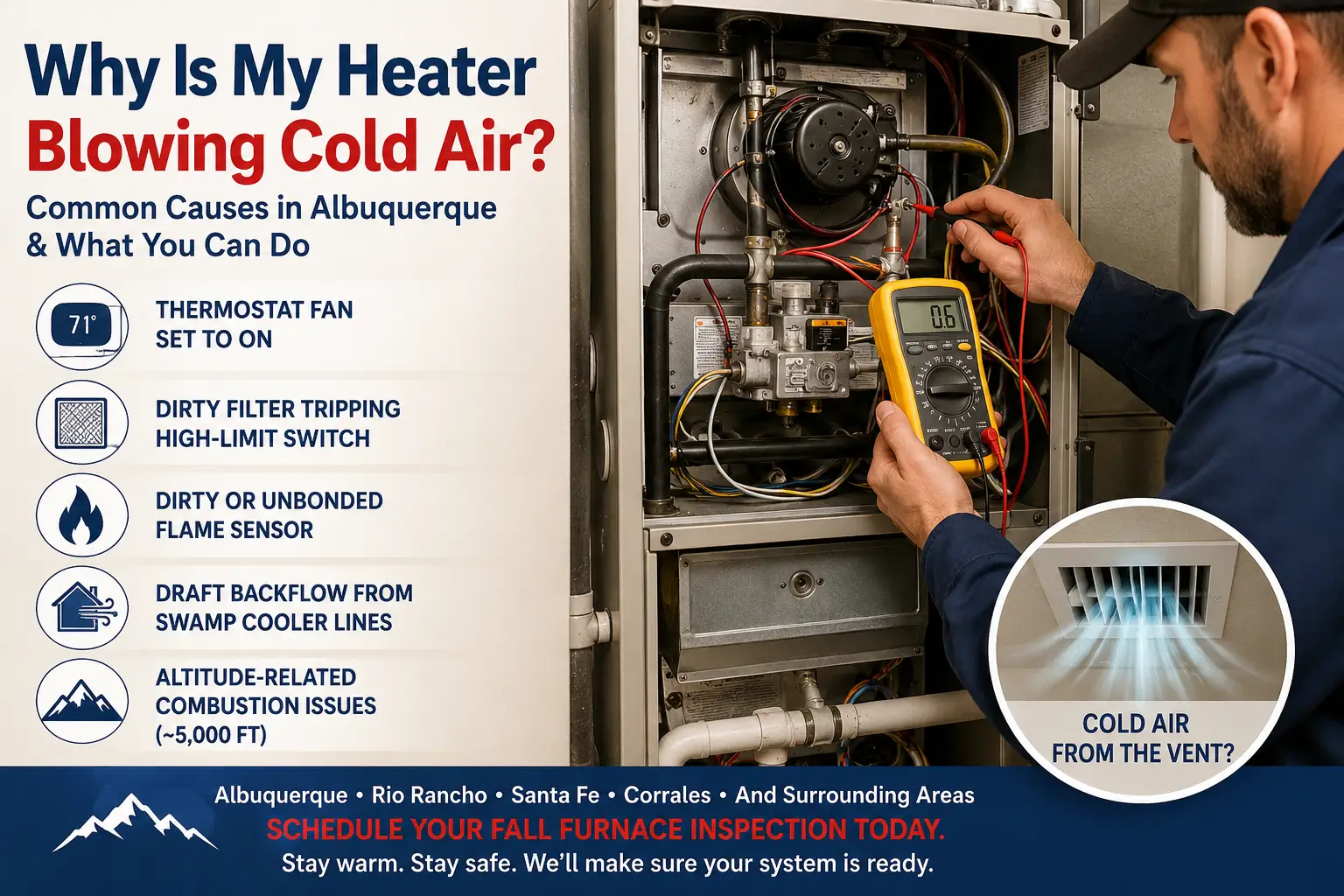
Before assuming your furnace isn't heating, check that the thermostat is set to HEAT and the fan is set to AUTO rather than ON. This is one of the most common causes we see. With the fan on ON, the blower can run continuously, including between heating cycles when the burners aren't operating, circulating 65°F to 68°F room-temperature air through the house. That air isn't unusually cold, but moving it across your skin certainly feels cold. Setting the fan to AUTO tells the blower to operate as part of the normal heating cycle instead of pushing unheated air around the clock.
If that doesn't solve the problem, it's time to look deeper.
This is the easy one, and it's worth ruling out first. If the thermostat is calling for 71°F but the fan is set to ON, the blower keeps running after the burners shut down, and the air at the registers stops feeling warm. Set the system to HEAT and the fan to AUTO. If the house still won't reach the temperature you've set, there's another problem.
This one matters more here than in most parts of the country. Albuquerque's dry climate and fine desert dust clog furnace filters surprisingly fast, and as the filter restricts, less air moves across the heat exchanger. The furnace is still producing heat; it just can't carry that heat away fast enough, and eventually it overheats and trips its high-limit safety switch.
What happens next confuses a lot of homeowners: the burners shut off, but the blower keeps running. That's intentional, because the furnace is trying to cool itself down. From the living room, it looks like a furnace that's running and blowing cold air. It's also why we don't assume a constantly running blower means a failed control board. The board may be responding exactly as designed to an overheating furnace.
Check the filter and replace it if it's dirty, make sure return-air grilles are clear, and confirm you haven't closed a large number of supply registers. Closing vents in unused rooms seems like an easy way to save energy, but closing too many raises duct static pressure, reduces airflow through the furnace, and contributes to high-limit problems.
This is one of the more interesting cold-air complaints, because you can often hear it happen. The ignition sequence starts, the burners light, and three to five seconds later the flame disappears. The blower then runs and sends cold air through the house.
The common assumption is that the flame sensor is bad. Usually it isn't. Flame sensors rarely fail electrically. More often the sensor is coated with silica, dust, or oxidation, or the furnace has lost the metal-to-metal grounding path the flame-sensing circuit depends on. That circuit operates on a tiny current measured in microamps, and if the control board can't confirm a flame is present, it closes the gas valve. That's a safety feature working correctly.
Replacing the sensor without determining why the board isn't receiving the flame signal often means replacing a good part. We frequently find that cleaning the sensor and restoring the grounding path resolves the problem entirely. This is also a point where professional diagnosis matters, since homeowners shouldn't be bypassing furnace safety controls or probing electrical circuits to find out why ignition is failing.
Older New Mexico homes tend to have a history. A house may have been built with a gas furnace and later had a roof-mounted evaporative cooler added, or the ductwork may have been modified over the years so the swamp cooler and furnace share portions of the supply system.
If the seasonal damper between the evaporative cooler and the heating system isn't properly sealed, cold outside air can travel down through the roof ductwork. On a windy winter day, that alone can noticeably cool your supply air, and it can create problems you'd never connect to a swamp cooler. We ran into exactly that in an older Albuquerque home.
The home was a 1960s brick ranch in the Albuquerque Foothills with an older 80% AFUE natural-gas upflow furnace in a tight utility closet, plus a roof-mounted evaporative cooler tied into shared supply ductwork.
On a cold November morning, the thermostat was set to 71°F and the house had fallen to 63°F. Air was coming through the vents, but it felt lukewarm at best. The obvious causes didn't pan out: the fan was already set to AUTO, and the filter was relatively clean.
So we watched the ignition sequence. The draft inducer started, the hot-surface igniter glowed, the burners lit normally, and roughly four to six seconds later the gas valve closed and the flame went out. The blower then circulated the ambient air sitting inside the system, which is what the homeowner was experiencing as cold air.
At first glance this looked like a textbook flame-sensor problem, but the sensor itself was clean. When we measured the flame-rectification circuit, we found zero microamps returning to the control board. That changed the diagnosis.
We traced it to the furnace's grounding path. An improperly sealed damper on the roof-mounted swamp cooler was allowing cold outside air to backdraft into the furnace closet during strong wind gusts. Over time that cold-air intrusion contributed to condensation around the furnace cabinet, and micro-corrosion developed around the burner assembly ground screw.
Small problem, big consequence. The flame sensor depends on a solid electrical ground through the furnace's metal frame, and the corrosion interrupted it. The burners were lighting correctly, but the control board couldn't electrically confirm the flame, so the furnace did what it was designed to do and shut off the gas.
We cleaned the burner mounting-bracket contacts, replaced the corroded ground screw, verified a solid ground path back to the control board, and cleaned the flame sensor. But simply getting the furnace running again wouldn't have addressed the cause, so we also installed a motorized backdraft damper in the swamp cooler duct line to keep cold exterior air out of the system and adjusted the gas manifold pressure for Albuquerque's altitude. Replacing the control board, gas valve, or flame sensor would have fixed nothing.
Altitude is another reason heating diagnosis works differently here. Albuquerque sits at roughly 5,000 feet, where the air is less dense than at sea level, and that affects gas combustion. Gas furnaces often require high-altitude derating through proper orifice sizing or manifold-pressure adjustment so the furnace maintains the correct air-to-fuel relationship.
A furnace that was never configured for altitude can develop lazy flames, soot buildup, ignition trouble, and pressure-switch issues. This becomes especially important when equipment has been replaced or modified without accounting for local elevation. Gas pressure isn't something a homeowner should adjust; proper combustion has to be measured and verified with the right HVAC instruments.
One of the biggest mistakes in furnace troubleshooting is swapping out whichever component seems closest to the symptom. A blower that won't stop running doesn't automatically mean a failed control board, since the board may be running the blower on purpose because a high-limit or other safety switch has opened. Burners that shut down after three to five seconds don't automatically mean a bad flame sensor, since contamination, oxidation, or a poor ground are more likely. And a gas valve that won't open doesn't automatically mean a bad gas valve, because the valve sits near the end of the safety sequence: if the draft inducer isn't creating adequate draft, if the pressure switch doesn't close, or if another safety circuit is open, the control board is supposed to withhold power from it.
Control boards, gas valves, and pressure switches do fail. But before replacing them, we want to know why the control system is behaving the way it is.
Before scheduling a repair, it's worth confirming that the thermostat is set to HEAT with the fan on AUTO, that the air filter isn't visibly dirty or clogged, that supply registers haven't been closed off around the house, and that furniture, drapes, or boxes aren't blocking return-air grilles. Also check that the furnace power switch hasn't been flipped off, and if you have a high-efficiency condensing furnace, look for any obvious surface-level obstruction in the condensate drain.
Beyond that, be cautious. A gas furnace combines electricity, natural gas, combustion, high temperatures, and carbon monoxide risk. Adjusting manifold gas pressure, testing gas-valve solenoids, diagnosing 120V and 24V circuits, inspecting heat exchangers for cracks, performing combustion analysis, and diagnosing pressure switches, flame-rollout switches, and internal safety wiring all belong to a qualified HVAC technician.
Most importantly, never bypass a furnace safety switch to keep the system running. If a limit or safety control trips repeatedly, resetting the furnace without finding out why doesn't repair anything. Repeated overheating can damage the heat exchanger, and combustion problems can create a carbon monoxide hazard.
Many homes in Albuquerque, Rio Rancho, Santa Fe, Corrales, and nearby communities weren't built around today's HVAC systems. We work on older gas furnaces, newer replacement furnaces, swamp-cooler and furnace combinations, heat pumps, radiant systems, and duct systems that have been modified several times over the life of the house. Ductwork runs through unconditioned attics and crawlspaces, old evaporative-cooler drops stay connected to the supply system, dampers leak, return-air systems come up undersized, and furnaces sometimes were never configured for altitude.
That's why "my heater is blowing cold air" isn't a diagnosis. It's a symptom, and the job is to find what's producing it before anyone starts replacing parts.
The worst time to discover a furnace problem is the first freezing morning, when everyone in Albuquerque is calling for heating repair at once. A fall inspection lets us check airflow, the filter and blower, the ignition sequence, flame sensing, safety controls, combustion, venting, heat-exchanger condition, and proper operation at our altitude before you're depending on the system every night.
And if your furnace is already blowing cold air, cycling repeatedly, failing to reach the thermostat setting, or shutting the burners down shortly after ignition, don't assume you know which part failed. Schedule a heating repair with Number One Plumbing and let us diagnose what's actually causing it. We've been serving New Mexico homeowners for more than 20 years, and every visit is backed by our Satisfaction Pledge.
Serving homeowners throughout Albuquerque, Rio Rancho, Santa Fe, Corrales, and surrounding communities.


