Es posible que no los notes al principio. Un leve goteo debajo del fregadero. Un leve silbido detrás de una pared. Un aumento repentino en su factura de agua que no coincide con su consumo. Estos son los «sifones silenciosos», es decir, las fugas ocultas en las tuberías que desperdician agua silenciosamente, aumentan los costos y preparan el terreno para daños costosos.
If you live in New Mexico, don't automatically assume your air conditioner is too small or needs more refrigerant. After 21 years of diagnosing HVAC and air conditioning problems in Albuquerque, Rio Rancho, Santa Fe, and the surrounding area, we've learned that a system can appear to be running normally while the actual heat-transfer process has broken down somewhere else entirely. Sometimes the problem isn't even inside the air conditioner. It can be in the ductwork above your ceiling, where your system may be pulling 120°F air out of a roof cavity.
We've seen it happen.
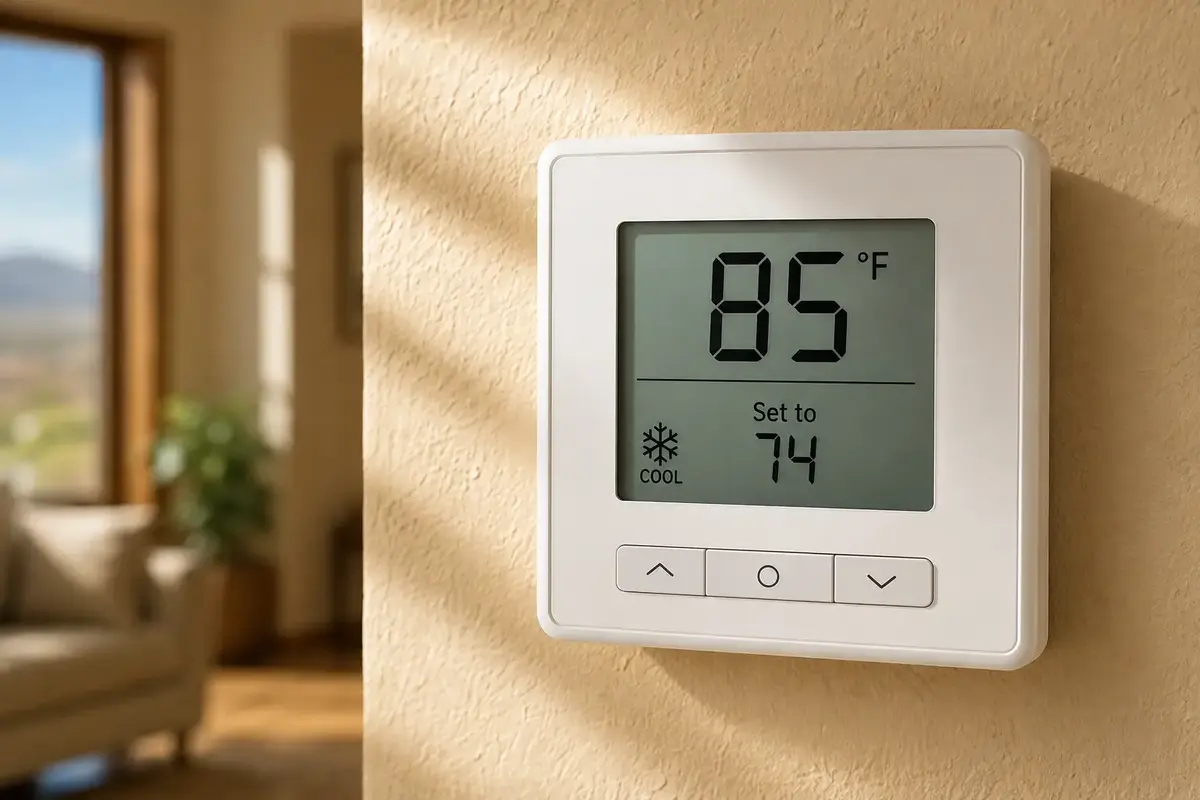
During a mid-July heatwave, we were called to an Albuquerque home built in the late 1990s. The homeowner had the thermostat set to 74°F, and the central air conditioner had been running continuously all day — yet the indoor temperature had climbed to 85°F.
At first glance, the system appeared to be operating. The thermostat was calling for cooling, the indoor blower was running, and air was coming from the supply registers, although it felt weak and warmer than it should have. On the rooftop packaged unit, the condenser fan was spinning and the compressor was humming. The return filter was somewhat dusty, but not completely clogged.
This is where a quick diagnosis can get expensive. Someone could easily look at those symptoms, connect a set of gauges, see an unusual suction pressure, and decide: "It's low on Freon."That's not what was wrong.
We started measuring what the system was actually doing. Refrigerant testing showed low suction pressure, high superheat, and lower-than-normal subcooling — readings that could initially point toward a refrigerant problem. But we kept testing.
The temperature difference between the return and supply air was only about 8°F. In our high-desert climate, we would typically expect roughly a 16°F to 20°F drop across a properly operating coil under appropriate conditions. Something wasn't right.
Then we measured Total External Static Pressure, or TESP. It came in at approximately 0.95 inches of water column against a manufacturer's recommended maximum of around 0.50 inches — the system was fighting nearly twice the recommended static pressure.
When we inspected the ductwork, we found the real problem. A major connection on the return plenum had separated inside the unconditioned roof cavity. Instead of pulling return air from the house, the air conditioner was sucking in air from a roof cavity that was approximately 120°F. At the same time, several legacy flex-duct runs were sagging, kinked, and poorly insulated.
The air conditioner wasn't simply trying to cool the house anymore. It was trying to cool superheated roof-cavity air while fighting severely restricted airflow — and then losing additional cooling through deteriorated supply ducts before the air ever reached the rooms. No amount of randomly adding refrigerant was going to fix that.
We sealed the return plenum, re-strapped and insulated the affected supply ducts, and adjusted blower operation to better manage static pressure. Supply-air temperature dropped to approximately 55°F, and the home returned to comfortable temperatures.
That experience illustrates one of the most important things homeowners should understand about an AC that "runs but doesn't cool": hearing your air conditioner run doesn't mean it's successfully removing heat from your house.
A lot of HVAC advice online is written as though every house and every climate are essentially the same. They're not.
Homes throughout Albuquerque, Rio Rancho, and Santa Fe operate in a high-desert environment that presents unusual challenges for air conditioning systems. Albuquerque sits at roughly 5,000 feet above sea level, and Santa Fe is considerably higher. At elevation, air is less dense — which means it's not enough to know that air is coming through a vent. What matters is the amount of air moving across the evaporator coil and whether the system can transfer enough heat out of the home. Duct sizing, blower performance, and static pressure become extremely important.
Then add our summer conditions. During July and August, temperatures can reach 100°F or more in parts of the region, with intense high-desert solar radiation beating down on roofs and outdoor equipment. Unlike humid climates, much of our cooling requirement is sensible heat removal — the system is primarily trying to lower air temperature rather than remove large quantities of humidity.
Many New Mexico homes also have flat roofs with packaged rooftop HVAC units that spend summer afternoons sitting directly in intense sunlight. That heat takes a toll on compressors, capacitors, electrical components, and condenser performance.
And then there's another distinctly New Mexican issue.
This is one of the first things worth considering when refrigerated air isn't performing properly. Many older homes throughout the Albuquerque and Rio Rancho area were originally designed around evaporative coolers and were later converted to refrigerated air or heat pumps. That's a major change in how the home's air-distribution system operates.
Evaporative cooling generally moves a high volume of air at relatively low pressure. Refrigerated air requires a much more carefully controlled and sealed supply-and-return system. Yet during some conversions, portions of the old duct system remain in place. Over the years, we've found legacy ductwork that is undersized, poorly insulated, kinked, sagging, or simply never designed for the static-pressure requirements of the newer equipment.
You can install excellent refrigerated-air equipment and still have a house that won't cool properly if the duct system can't deliver what the equipment produces. That's why replacing the air conditioner isn't always the answer.
After 21 years working on cooling systems in New Mexico's high-desert climate, these are five of the problems we encounter most often.
This one is particularly common during extreme summer heat. The capacitor helps start and run the outdoor compressor and fan motor. When it fails, your indoor blower may continue operating normally — so from inside the house, it sounds like the AC is running. But the compressor may not actually be doing its job, and the result is room-temperature air coming from the registers.
Fortunately, this doesn't automatically mean you need a new air conditioner. A trained technician can test a capacitor relatively quickly.
A severely dirty filter can do more than reduce the amount of air coming from your vents — it can starve the evaporator coil of airflow. Without enough warm household air moving across that cold coil, the coil temperature can fall below freezing. Moisture begins freezing onto the coil, restricting airflow even further, until eventually you can have a block of ice inside the air handler.
The homeowner feels weak airflow and assumes the AC needs refrigerant. Maybe it does — but airflow needs to be checked first. Dirty evaporator coils, dirty blower wheels, undersized returns, closed vents, and collapsing ductwork can all create similar symptoms.
This is one we believe deserves far more attention, particularly in older and retrofitted New Mexico homes. A supply duct can separate and dump cooled air directly into an attic or roof cavity. A return duct can separate and do the opposite: pull extremely hot air into the HVAC system. If your roof cavity is 120°F or hotter, your air conditioner suddenly has an enormous additional heat load — enough to make a properly sized system look undersized.
We've seen homeowners facing what appears to be an expensive equipment problem when the real solution is repairing a duct connection. That's why looking at the AC equipment isn't enough. Sometimes you have to find out where the air is actually going.
Your air conditioner doesn't "make cold" in the way many people imagine. Its job is to absorb heat inside the house and reject that heat outdoors, and the condenser coil is critical to that process.
If the outdoor coil becomes covered with dust, cottonwood fluff, grass clippings, or other debris, it can't reject heat efficiently — a serious problem in a climate where outdoor equipment may already be operating under extremely hot conditions. Head pressure rises, the compressor works harder, and eventually thermal protection may shut the compressor down. The unit can still have electrical power, and some components may continue operating, but the house isn't cooling.
Yes, sometimes the system really is low on refrigerant. But here's the important distinction: an air conditioner does not use up refrigerant. Refrigerant isn't fuel. It's contained within a closed system, so if your AC is genuinely low, there's a reason — somewhere, refrigerant has escaped. That leak should be diagnosed rather than treating the system as though it simply needs a "top-off" every summer.
A restricted thermal expansion valve (TXV) or another metering-device problem can also interfere with refrigerant flow and heat absorption. Those problems require proper measurements to distinguish them from airflow issues.
Of all the misconceptions we've encountered in 21 years, this is the one we most want homeowners to understand: low suction pressure does not automatically mean low refrigerant.
Gauges measure pressure. They don't simply tell a technician how many pounds of refrigerant are inside the system. Low airflow across the evaporator coil can also cause suction pressure to drop. Picture an extremely dirty filter, a restricted return duct, or a dirty blower wheel: not enough warm household air reaches the evaporator coil, heat transfer falls, coil temperature falls, and refrigerant pressure changes. Someone who looks only at the pressure can mistake that condition for low refrigerant.
Then refrigerant gets added to a system that may already have the correct charge — and now you've potentially created another problem. An incorrectly charged system can operate poorly and place additional stress on the compressor. Under certain fault conditions, liquid refrigerant returning where vapor is expected can contribute to serious compressor damage.
The homeowner came in with an airflow problem and can leave with an airflow problem plus an incorrectly charged system. That's why we don't believe "throw some Freon in it" is a diagnosis.
When we investigate an AC that runs but doesn't cool properly, we're trying to determine where the heat-transfer process is failing. That requires looking at the system as a whole.
Before refrigerant readings can be properly interpreted, airflow needs to be evaluated. That includes checking the filter, supply registers, return system, blower operation, and restrictions within the air-distribution system. We can also measure Total External Static Pressure (TESP) with a manometer. Think of static pressure as blood pressure for your duct system: if resistance is excessive, the blower can't move the amount of air the system needs.
As a general diagnostic benchmark, residential systems are often designed around roughly 350 to 450 CFM per ton — and in a dry climate like ours, proper airflow tends to run toward the higher end of that range because the system is doing mostly sensible cooling. Actual required airflow depends on the equipment, application, elevation, manufacturer specifications, and operating conditions. At elevations like ours, those details matter.
Next, we measure the temperature of the air entering the system and compare it with the conditioned air leaving the evaporator coil. In our arid climate, a properly operating system will often produce roughly a 16°F to 20°F difference under appropriate test conditions.
Remember our Albuquerque case? We measured only 8°F. That was an immediate signal to keep investigating.
Once adequate airflow has been established, refrigerant diagnostics become much more meaningful. Depending on the system and metering device, that can involve measuring superheat and/or subcooling and comparing those readings with manufacturer specifications and actual operating conditions. Raw gauge pressure by itself doesn't tell the whole story.
Don't Forget the If the equipment is producing an appropriate temperature drop but the rooms remain hot, the question changes: where is that cooled air going? That's when inspecting ducts in attics, crawl spaces, and roof cavities becomes essential. We look for disconnected ducts, torn flex duct, crushed or kinked runs, deteriorated insulation, leaking return plenums, and other problems that can cause tremendous cooling losses. For homes converted from evaporative cooling to refrigerated air, this inspection can be especially important.
During a New Mexico heatwave, an air conditioner running for long periods isn't automatically malfunctioning. The system may be dealing with 100°F+ outdoor temperatures, intense solar heat gain, and a large gap between the thermostat setting and outdoor conditions.
What concerns us is a system that runs continuously while losing ground. If you've set the thermostat to 74°F and the house keeps climbing toward 84°F or 85°F, something deserves investigation.
Pay attention to the combination of symptoms. Is airflow much weaker than normal, and is the air from the vents actually cold? Did the problem appear suddenly, or does one part of the house stay much hotter than another? Is the outdoor equipment starting and stopping unexpectedly? Was the home converted from a swamp cooler, and are the ducts located in an attic or hot roof cavity? Has someone repeatedly added refrigerant without ever identifying a leak? Those clues tell us far more than simply knowing that "the AC is running."
This may be the biggest takeaway from our experience: a house that won't cool doesn't automatically have an undersized or worn-out air conditioner.
We've seen duct problems make properly sized equipment appear inadequate. We've seen airflow restrictions create refrigerant-pressure readings that get misinterpreted as low charge. We've seen electrical components fail under extreme summer heat while the indoor blower keeps running, convincing homeowners the entire system is operating. And we've seen refrigerated-air conversions inherit duct systems that were never designed for the equipment attached to them.
Replacing the equipment without identifying those problems doesn't solve them. You can put a brand-new air conditioner on bad ductwork and still have a hot house.
If you're in Albuquerque, Rio Rancho, Santa Fe, or the surrounding area and your air conditioner is running but your home isn't getting comfortable, don't start by assuming you need more refrigerant or a larger AC. Start with a diagnosis.
Number One Plumbing has spent 21 years diagnosing HVAC and air conditioning problems in New Mexico's high-desert environment. For homes that aren't cooling properly — particularly older homes and properties converted from evaporative cooling to refrigerated air — a comprehensive diagnostic examines the factors that quick service calls sometimes miss: Total External Static Pressure, the temperature split across the system, superheat and subcooling, blower and airflow performance, and attic and roof-cavity duct integrity.
The goal isn't to guess which part to replace. It's to find out where your cooling is actually being lost.
Schedule a Comprehensive Diagnostic & Static Pressure Inspection with Number One Plumbing before spending money on another refrigerant recharge or assuming you need a new air conditioner.
For most homes in the Albuquerque area, an annual inspection is a good baseline. Homes with pets, significant dust exposure, or cottonwood nearby may benefit from cleaning more frequently — sometimes every season.
A standard cleaning typically involves a surface rinse or light brush-down during a routine tune-up. A deep cleaning involves full access to the coil interior, dry debris removal, chemical treatment, and a controlled rinse — and is necessary when buildup is heavy or performance has noticeably declined.
Surface debris like cottonwood can be carefully removed from the outdoor unit by a homeowner. The evaporator coil inside the air handler requires proper access, the right cleaning agents, and care around sensitive components — DIY attempts often cause fin damage or introduce moisture where it shouldn't go.
A musty or "dirty sock" smell at startup is one of the most common signs of biological growth on the evaporator coil. A deep cleaning combined with a drain line flush typically resolves it.
A system working against a clogged coil runs longer and less efficiently than it should. Restoring clean heat transfer surfaces reduces runtime, which typically results in lower energy consumption — though exact savings depend on the condition of the system and the home overall.
Signs include little to no cool air from the vents, ice visible on the refrigerant lines near the air handler, or water pooling around the unit as ice melts. If you suspect a frozen coil, turn the system to fan-only mode to thaw it and call for an inspection before running it again.
